The 1877 International Association and the Demise of Columbus’s First Buckeyes

In 1877, the word Buckeyes in Columbus had nothing to do with The Ohio State University. The institution on Neil Avenue existed, but it was still the Ohio Agricultural and Mechanical College—barely a hundred students and a baseball team called the Franklins. In the city, Buckeyes meant professional baseball. The college boys along the Olentangy were the Franklins; the pros at the Union Station grounds were the Buckeyes.
Columbus Buckeyes
38-37-6, 4-8-International Association
Buckeye Base Ball Grounds, North Union Station Depot
1877

The Buckeyes entered 1877 riding a wave of optimism. Their 1876 independent season had been successful, and though they’d lost their star pitcher, Ed “The Only” Nolan, to Indianapolis, much of the core returned. Expectations were high.
.JPG)
The National League was only in its second year and already trying to rein in the scattered world of professional clubs outside its walls. It drafted a League Agreement to standardize rules and create what it considered a “minor” circuit—though that concept didn’t exist yet—called the League Alliance. The Buckeyes were fine with most of it until they got to the part where disputes would be settled by the National League’s own board. That was going too far. Columbus recognized that non-League clubs needed their own organization and refused to sign.

A convention was proposed for Philadelphia, but Columbus had enough influence—rumor had it that President Rutherford B. Hayes himself was a stockholder—that the meeting was moved to Pittsburgh. On February 20, 1877, in the St. Clair Hotel, the International Association was founded. Buckeye business manager Jimmy Williams represented Columbus and was named the league’s secretary and treasurer. Seven teams made up that first season. Today, the International Association is considered the first minor league, and Williams the “father” of minor league baseball, but in its own time, it was meant to compete directly with the National League.
Despite returning players like catcher Billy Barnie, shortstop Mike Burke, and second baseman George Strief, the 1877 Buckeyes never matched the success of the season before. They wouldn’t even make it to the end of the year. But for a while, they played tough, hovering near .500 overall. League turmoil didn’t help: the Lynn Live Oaks disbanded before finishing their schedule, causing some Buckeye wins to be wiped from the standings.
Williams’ new league duties meant he couldn’t continue as Buckeyes business manager, so Barnie—still the catcher—took over. Strief was named captain, with center fielder Frank Fleet as his assistant. On April 23, the Buckeyes opened at home against the National League’s Louisville Grays.

The Union Station grounds had received upgrades—rolled outfield, a smoother infield—but the Buckeyes had practiced for only a week. It showed. New pitcher Jim McCormick was shelled in a 10–1 loss. The next day, in cold drizzle, Callahan pitched, and McCormick moved to right field; the team looked sharper but still lost, 4–2. Barnie absorbed early-season jeers while juggling playing and managing. McCormick and Callahan formed an unusual two-man pitching tandem the rest of the year.
John Magner replaced Callahan in the outfield, but after a demoralizing 11–2 loss to Cincinnati, the Buckeyes embarked on their first road trip, having surrendered 25 runs in three straight defeats. Media interest, strong the previous year, waned. The Dispatch quit running box scores, leaving The Ohio State Journal as the primary chronicler.
Their first International Association game came in Pittsburgh, where Pud Galvin—future Hall of Famer—threw the league’s first-ever shutout against Columbus. Rain wiped out the second game with the Buckeyes leading, echoing an earlier rainout in Wheeling. When the Bucks returned to Wheeling on May 2, they finally picked up win number one, 13–7.

A home date with the powerhouse Boston Reds followed—another loss. Barnie struggled to attract teams to Columbus, leaving week-long gaps in the schedule. An old friend, Ed Nolan, now with Indianapolis, greeted the Buckeyes with a no-hitter.
By mid-May, whispers appeared in newspapers as far as New Jersey that McCormick, likely unhappy with his workload, might jump to the reorganized Paterson Olympics. Whatever tensions existed, he stayed, and after a home-and-home with Springfield, Columbus finally hosted its first International Association games against the Lynn, Massachusetts Live Oaks.

Columbus swept the Live Oaks and roughed up future Hall-of-Fame pitcher Candy Cummings, but the wins would later vanish when Lynn folded in September. A sweep of Memphis pushed the Buckeyes above .500 for the first time (8–7). But the Brooklyn Hartfords snapped Columbus’s six-game streak just as the Bucks embarked on a massive June road trip—six weeks, thirty games, and 2,600 miles. A long absence from home did not help keep fans invested.
The Bucks performed decently on the trip, and McCormick rediscovered his form. They signed veteran Charlie Pabor; Magner left for Rochester. Eddie Booth fell ill, forcing a rotating cast into right field. They hammered Cummings once again for ten runs in a rematch with Lynn.

On Dominion Day in Hamilton, Canada, Strief—normally at second—had to pitch because McCormick and Callahan were worn down. Shortly afterward, the Bucks signed Cincinnati castoff Bobby Mathews, but his pitching didn’t hold up. By July 5, when the team finally staggered back into Columbus, The Journal called their trip “the longest and hardest in base ball history.”
As July wore on, disaster struck—not with the Buckeyes, but in Pittsburgh. The Railroad Strike of 1877 escalated into violence, shutting down railroads, burning roundhouses, and killing more than sixty people. The fallout rippled nationwide, and although just a footnote to the larger upheaval, baseball schedules were impacted.

Games were canceled. The Syracuse Stars simply didn’t show. Wheeling had no train service. The Buckeyes played a benefit game for Fleet, who had just been released, but meaningful games were hard to come by. Whether it was the strike, Barnie’s difficulty scheduling opponents, or both, the team was struggling.
When the St. Louis Browns finally reached Columbus on August 3, the crowd was packed with National Guardsmen stationed at Union Station because of the strike. The Buckeyes played one of their best games, but Barnie broke his finger, ending his season behind the plate. A soldier capped the afternoon by accidentally firing his gun into the bleachers' roof.
With Barnie out, McCormick recommended a replacement: his friend Mike Kelly, future Hall of Famer “King” Kelly. Columbus also signed Martin Nolan, a local law student and former Buckeye.
Plans for a late-August tournament in Mt. Vernon fizzled. Few teams showed, the purse dropped from $800 to $300, and after the Buckeyes arrived one morning, they found the gates locked because the treasurer had skipped town. They played Springfield anyway for the gate: $35.
Rumors circulated that the International Association might fold or switch to cheaper rosters the following season. Players began signing elsewhere for 1878: Burke to the Tecumsehs, Sullivan to Indianapolis, Barnie to Buffalo.

Still, the Buckeyes managed one of their signature wins—beating the National League–leading Louisville Grays on September 5. Unbeknownst to anyone, Louisville players Devlin and Hall were in Columbus plotting a gambling fix that would soon get them banned from baseball for life.
Barnie was released so he could join Buffalo, and after his departure, scheduling became impossible. A full week went by before three games against Rochester. With no more games lined up, the Columbus Buckeyes officially disbanded at noon on September 15, 1877. Small crowds and an empty schedule finally caught up with them. A new certificate of incorporation was filed for an 1878 Buckeyes club, but nothing came of it.

A September 17 benefit game threw together remaining Buckeyes, Springfield players, and local talent. McCormick went to Indianapolis. Kelly, Callahan, and Fleet to Hornellsville. Sullivan to Cincinnati. Strief to Allegheny. Because Lynn folded before playing every team, none of their games counted; Columbus’s official league record was 4–8, and their overall final mark was 38–37–6. When all the dust settled, the London Tecumsehs took the 1877 International Association pennant.
Columbus wouldn’t field another professional baseball team for six years. In the nineteenth century, team nicknames were fluid, but Buckeye—a term for Ohioans since the 1700s—became closely tied to baseball thanks to the 1876–77 club. Other Buckeye teams would follow.

In May 1878, the Ohio Agricultural and Mechanical College became The Ohio State University. The school now claims its 1881 team as the first formal OSU baseball squad. How closely the old Franklins were tied to the institution isn’t entirely clear, but thanks to second baseman John McQuigg’s letter to the OSU Monthly, we know the Franklins once played on Professor Mendenhall's property long before Buckeyes meant scarlet and gray.
And for a brief chapter in the 1870s, when Columbus talked about the Buckeyes, they meant the pros at Union Station—scrapping, barnstorming, breaking fingers, fighting train strikes, and trying to give the National League a run for its money.
The 1877 Columbus Buckeyes
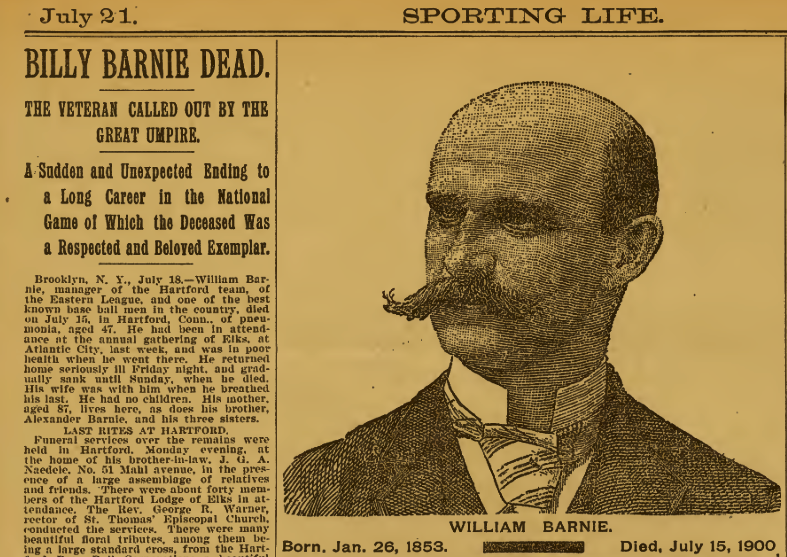
William Harrison “Billy” Barnie - catcher, business manager
Returned from the '76 Buckeyes. Known for fearlessness, pluck and endurance. Good batter and base runner. Barnie's streak of consecutive games catching ended at 84 on August 3 with a broken finger. Barnie signed with the new Buffalo franchise on August 27 and was released on September 1.

James “Jim” McCormick - pitcher, utility
One of the early curveball pitchers. Played with the Paterson Olympics in 1876. Cool and collected. Fair batter and base runner. McCormick was great friends with Mike "King" Kelly. The Buckeyes recruited McCormick in 1877. When they disbanded in September, he was picked up by the Indianapolis Blues. Several folks are making the case he should be in the Hall of Fame.

John Frank "Chub" Sullivan - first base
From Boston and known as the best first baseman in New England. Played with Taunton and Ithaca in ‘76. Led his club in batting the prior two seasons and was also a good base runner. “Chub” was more likely a reference to his thin frame – 6′ 0″ and maybe 165 pounds. Played first for every game of the Buckeye’s season. During his career, he was a popular player, sometimes known as a clown for his antics, and an early pioneer of the slide. After going to the Reds when the Buckeyes disbanded, Sullivan stayed on with the Reds for the 1878 season, leading the league in games played, assists by a first baseman, and fielding percentage (.975).

George Andrew Strief - second base, center field, captain
Reliable defense and hard working. Played with Bucks the latter half of ‘76. Good base runner but struggled at the plate in ‘76. After baseball, he worked as a policeman in Cleveland.
Harrison “Harry” Leslie Spence - third base
From New York. Played with the Maple Leafs for several years before playing with New Haven in ‘76. Quick and a good thrower. Good batter and fine base runner. Played every game of the season at third.
Michael E. “Mike” Burke - short stop
Played with the Buckeyes in 1876. One of the best shortstops in the country. Good batter, excellent base runner. Played every game of the season at short. Went to the London Tecumsehs and won the championship after the Bucks disbanded.

John Magner - left field
Played with the St. Louis Reds in 1876. Known for his speed. Injured his hand during practice before the season opener. Played 17 games with the Bucks before being released on June 10. Played with Rochester and the Tecumsehs before finishing the season with St. Paul.
Frank H. Fleet - center field, second base, assistant captain

Played second base for New Haven in 1876. Could play all positions. Best batter on the team and a very fine base runner. Released on July 27 and signed with Springfield. He would umpire the August 28 Buckeye game.

Edwin H. “Eddie” Booth - right field

Played with the New York Mutuals in 1875 and ‘76. Fast, fine batter and fielder. Very fine base runner and hard worker. Became ill on the Buckeyes long road trip and was out from June 26 to July 14.

Edward Callahan - change pitcher, left field

Played with Brooklyn Amateurs and Jersey City Enterprise before joining the Bucks in 1876. Not much is known about Callahan, and his first name was rarely, if ever, mentioned in news accounts. Most baseball reference sites list him simply as “Callahan.” His first name was "Edward" per the 1877 Columbus City Directory, which only adds to the confusion, as the best known Callahan of the era was also an Edward. That Callahan, known as an outfielder and shortstop, came up in Boston, while the Buckeyes’ Callahan, known primarily as a pitcher, came up in Brooklyn. The tenth man, he started on opening day instead of Magner due to injury.


Charles Henry “Charlie” Pabor - left field, captain

Joined the Buckeyes on May 30, his seventeenth season in baseball. Captained the team on June 1. Played in what is considered the first professional baseball game in 1871.


Robert T. “Bobby” Mathews - pitcher

Acquired by the Bucks on June 29 from the Cincinnati Reds. He is the 25th winningest pitcher in MLB history, has the most career innings pitched and the second-highest number of wins (behind Roger Clemens) for a pitcher not elected to the Baseball Hall of Fame. Released on July 27.

T. Welch - catcher, right field
Signed in late July. Almost nothing is known. He played for Springfield earlier in the season. He is often listed as Welsh.
Michael Joseph "King" Kelly - catcher
From Troy, NY/Paterson, NJ. Signed by the Buckeyes on August 6. Signed with the Cincinnati Reds in 1878. Inducted to the Hall of Fame in 1945.

Comments