Q-FM-96 Hometown Album Project

Considering that three of the acts would go on to sign major-label deals and that the first pressing of 5,000 copies quickly sold out, I feel comfortable saying that the Q-FM-96 Hometown Album Project is the most successful compilation of Columbus music—both commercially and artistically—ever released. While we’re fortunate today to have great non-commercial stations that still support local music, like WCBE, this project happened before deregulation hollowed out commercial radio and replaced it with the corporatized, homogenized, relevance-free industry we live with now.
1979

Although the series would eventually grow to ten volumes, the first Hometown Album, released just before Christmas 1979, sprang from a near-perfect confluence of time, place, and industry. It was local radio doing exactly what it should do: documenting, amplifying, and believing in the music being made in its own backyard.

1979 was also the year my family moved to Columbus from Dayton, Ohio. Music is woven through those memories. My mom made regular trips to Buzzard’s Nest Records, and sometimes she brought my brother and I along. My dad had a cool vinyl collection and would shop for casettes to play in the car. I could walk to Rink’s, which had a surprisingly decent selection of music of its own. I was still a young kid, and while I have vivid musical memories from before then, this was the period when I really started paying attention.
I couldn’t afford to buy my own records yet, but Rink’s had those little chart cards by the music section. The first time I remember checking to see what was #1, it was Peaches & Herb’s “Reunited.” I didn’t like it—still don’t—and I remember realizing that the charts were not a reliable way to find good music. Or at least music I liked.

Q-FM played music I liked. I remember listening to Pat, Wags, and J.J. during early-morning paper routes. Dr. Demento on Sunday nights in my dad’s car. Russell Carey and Psychedelic Sunday (brought to you by Bent Back Records). This was radio that felt plugged into the city it served.

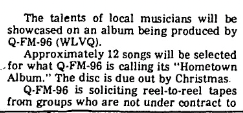
Mark Wagner (Daddy Wags) was hired by Q-FM in the fall of 1979, just as the station began accepting tape submissions for what would become the first Hometown Album. Roughly 150 tapes—representing more than 300 songs—came in. Program director Tom Teuber helped winnow those submissions before turning them over to a three-member outside panel that included major-label A&R reps like Bruce Ravid, who was riding high at the time for signing The Knack to Capitol.
Once the initial pressing sold out, Teuber worked with the Agora to arrange a series of live shows featuring bands from the album, broadcast live on Tuesdays at 10 p.m. Let that sink in for a moment. Local bands. Live broadcasts. Prime evening radio. It’s almost unimaginable now.

The shows were split between the Agora and Zachariah’s Red-Eye Saloon, beginning February 19, 1980, with The Muffs at the Agora. In the end, the album sold 10,000 copies, and a second Hometown Album was immediately put into motion.
What follows is a rundown of the eleven tracks on the first volume. The liner notes list only songwriting credits, so I’ve done my best to reconstruct personnel and context. If you spot any errors, please leave a comment—I’d genuinely love to get it right.

Frank Pierce Groupe – Livin’ On You
Written by Frank Pierce
The album opens strong with this solid rocker from songwriter and multi-instrumentalist Frank Pierce. There’s a bit of a Southern rock feel here, anchored by a killer guitar solo from John Boerstler. The Frank Pierce Groupe appears to have been assembled specifically for this project; the band didn’t start gigging until January 1980, after the album’s release.

The lineup around this period included Pierce (drums, vocals), John Boerstler (lead guitar, vocals), Bob Kocher (bass, vocals), Vince Schoenborn (keyboards), and John Leshe (guitar).
Pierce grew up in Upper Arlington and played in a long succession of Columbus bands, starting with his Hastings Middle School group The Specters, and continuing through Sweat Bighouse, Chylde, Outrageous, Charlie Bleak, and Tyler (named for his son). He would go on to appear on multiple Hometown Albums, work with Sally Fingerett, produce Snapshot, and help found Amerisound Studios, which still exists today.

He also played in Chuck Berry’s pickup band for a 1986 Columbus show—the only time I ever saw Pierce perform. Sadly, he passed away in 1988 at just 38 years old. John Boerstler would later record for MCA with the Artimus Pyle Band and continues to perform in Columbus.

Written by Gary Whitman
Next up is a thumping prog-rock track with high-register vocals and a loud, trebly bass presence. Credited here to Gary Whitman, this project would soon coalesce into the band Citadel. The lineup at the time included Whitman on keyboards and guitars, Fletcher Neal Hutchison on drums, and Wayne Stephens on bass.

The band relocated to Los Angeles shortly after their Agora performance in March 1980. Whitman later helped launch the annual ProgFest in L.A., and Citadel opened the inaugural festival in 1993.
Written by Bob McNelley

This song would later appear as the final track on McGuffey Lane’s 1980 self-titled debut, which earned the band a deal with Atco Records. Billboard singled it out as one of the album’s strongest tracks in a November 1980 review.
The personnel from this period includes Bob McNelley, Vocals, Acoustic Guitar; John Schwab, Electric Guitar, Acoustic Guitar, Vocals; Terry Efaw, Steel Guitar, Acoustic Guitar; Stephen Douglass, Vocals; Stephen Reis, Bass Guitar, Vocals; and John Campigotto, Percussion. Songwriter Bob McNelley passed away in 1987, but McGuffey Lane continues to perform, having long since secured their place in Columbus music history.

Written by Geoff Tyus
Things turn jazzy with this piano instrumental from Geoff Tyus, who had already been performing for over a decade by the time this album was released. The track also appears on his 1979 album Continuation, with Jim Curlis on drums.
Tyus continued performing for decades and remained a vital presence until his passing on October 7, 2007.
Written by Willie Phoenix

This track comes from one of Willie Phoenix’s early bands, The Buttons, which evolved out of Romantic Noise. Although Jerry Hanahan joined the group around this time, drummer Dee Hunt was still in the band when this track was recorded, according to roadie Rikki C. Bassist Greg Glasgow and lead guitarist John Ballor rounded out the lineup.
The Buttons were one of the hottest bands in Columbus in late 1979, famously opening for Talking Heads at Mershon Auditorium on Halloween. They played the final Hometown Album simulcast at the Agora on April 8, 1980.

The band didn’t last long, but Phoenix, of course, went on to sign with A&M Records, have a street named after him, and continue performing as one of Columbus’s true living legends. A strong way to end side one.
Written by Edd Key
Side two opens with this Edd Key song from Spittin’ Image, which would later close out the band’s debut album before they signed with MCA Records. Fronted by Mimi Rousseau, the band split up in 1983 but left a lasting mark on the city’s music scene. This lineup included Denny Petroff, guitar and keyboards; Blair Forward, bass; Chip Vivian, drums and Mark Foster guesting on organ. Frank Pierce also worked with the band and Rousseau’s later solo projects.

Written by Robin Snyder
Champ is another band that didn't exist, as a live act anyway, before the Hometown Album. Snyder and keyboardist Gregg Seibert had been recording as Champ, but their first gig as a band was the April 1, 1980 Hometown Album show at the Agora.
Champ’s initial lineup featured Snyder (guitar, vocals), Kristin Sad (lead vocals), Seibert (keyboards), Chris Sidwell (bass, vocals), and Scott Shepherd (drums, vocals). Snyder continues to write and record.
Written by Dave Show

Bassist Dave Show (miscredited as “Shaw” on the label) wrote this country-tinged tune. The lineup included Show (bass, vocals), Mike Kontras (keyboards, vocals), Pete Goldhardt (drums, vocals), Dan Westbrock (guitar, vocals), and Mark Harbold (pedal steel, vocals).
The song was recorded in fall 1977 and independently released as a single in early 1978, making it one of the album’s earliest recordings.

Written by Tom Weisend
Originally formed in Zanesville as the Muff Bros in 1975, the band moved to Columbus in 1976 and became The Muffs shortly before the album’s release. This melodic ballad was written by guitarist Tom Weisend.

The lineup at the time included Steve Sines (lead vocals), Weisend (lead guitar, vocals), Dennis Boyd (drums), Jim Edwards (lead vocals, rhythm guitar, keyboards), and John Durzo (bass, vocals). The band later signed with Earthtone Recording Company, released an album in 1981, and eventually became Money.
Written by Gerry Crabbe, Bruce Barnett

This stripped-down reggae tune features Gerry Crabbe, with Bruce Barnett on drums. Crabbe had previously played in Timberwolf and was a familiar presence at Zachariah’s, but there’s little evidence that the Pagen Brothers Band existed beyond this recording. My best guess is that the name was created specifically for the album.
Crabbe passed away in September 1984 at just 32 years old.
Written by Dan Keller

“Country Rocker” is an entirely accurate title for this Dan Keller song, steeped in Southern rock feel. Keller had previously played in Myth Band. Roughrider appeared at the Agora on February 26, 1980, as part of the Hometown Album simulcast series, and Keller continued to perform in bands like Hell-n-Keller.

With its distinctive Mark Ulrich–designed cover—featuring a cow painting, Victrola, and guitar gradually filling a living-room scene—WLVQ’s Steve Runner and Tom Teuber absolutely nailed this record. Nine more volumes would follow, including a tenth released in 2021 after a 33-year break.
The album works both as a collection and as a snapshot of the rock-leaning side of the late-’70s Columbus scene. Its $2.96 price tag was a savvy piece of marketing, and the proceeds went to WLVQ's Secret Santa fund, but the music is what made it endure. It may be the most iconic Columbus record there is.

Companies, etc.
Recorded At – Owl Recording Studios
Recorded At – Appalachia Sound Studios
Recorded At – Star Track Studios
Recorded At – Kingsmill Recording Studio
Recorded At – Fifth Floor Recording Studios
Lacquer Cut At – Diskwerks
Credits
Producer – Steve Runner
Executive-Producer – Tom Teuber
Lacquer Cut By – Ron Lewter
Cover – Mark Ulrich
Liner Notes – Gary Wolf


Comments