Dwight Yoakam – Guitars, Cadillacs, Etc., Etc.

The fact that three of Columbus’ most successful musical expatriates—Nancy Wilson, Rahsaan Roland Kirk, and Dwight Yoakam—play such disparate styles of music tells you something about the nature of this city’s music scene. In a place where the Midwestern “keep to yourself” ethos of humility and privacy permeates the culture, the music community reflects that same sensibility. There are parallels in their stories, but the reasons they left—and the paths they took to success—are distinctly their own.
Reprise Records - 9 25372-1
1986


Surprisingly, Dwight Yoakam may have had the lowest local profile of the three when he left town. "In Columbus, the only people who seem to know Dwight Yoakam are his immediate family, a few hip campus record store clerks and the country radio stations who won't play (him)," John Petric wrote in 1985. And, ironically, he had to leave Nashville as well to gain acceptance for his hard-edged honky-tonk revivalism in early-’80s Los Angeles. What began as an EP on the tiny Oak Records label was eventually expanded and reissued by Reprise Records in 1986. The record would go double platinum and alter the trajectory of modern country music, Guitars, Cadillacs, Etc., Etc..
A musician of Yoakam’s stature might have surfaced earlier on a Columbus music blog if his ties to the city were more widely understood. Unlike jazz trumpeter Harry Edison—also born in a small Kentucky town but long associated with Columbus—Yoakam’s local upbringing tends to be overshadowed by his Pikeville, Kentucky birthplace.

For a country artist, that emphasis makes sense. His parents were married in Columbus, but his mother, Ruth Ann, returned to her parents’ home in Betsy Layne, Kentucky when his father, David, was sent to Korea with the Army. Dwight was born in Pikeville in October 1956—the nearest town with a hospital. He was nine months old before his father returned home, bringing with him a black-and-white Kay guitar. The family soon moved back to Columbus.


They made frequent trips to Kentucky, ties Yoakam would later chronicle in songs like “South of Cincinnati” and “Readin’, Rightin’, Rt. 23.” He lived in Columbus through high school and into his time at Ohio State before leaving in the winter of 1977 to pursue music full-time. Edison always claimed Columbus as home; Yoakam has consistently leaned toward his Kentucky roots. For Yoakam, the connection to Kentucky isn't just sincere, but almost spiritual. "You have to break the ties to be yourself, and then you see how much those ties meant to you, so you try to put them back," he told writer Ronni Lundy. "Only you can’t really do it. You can’t do either all the way. But that’s where the story is, right? That place in the middle, isn’t that where it’s art?”
Yoakam gravitated to his father’s guitar almost immediately—until he fell on it and crushed it. He wrote his first song at eight after receiving a proper instrument for Christmas. He later took up drums, played bass drum in the Northland High School marching band, and discovered theater through an eighth-grade history teacher who launched a drama program. That theatricality would remain a crucial part of his stage presence.


In high school, he formed Dwight and The Greasers after overhearing a group of stage band members attempting rockabilly for a variety show. He walked into the band room, grabbed the mic, and surprised everyone—including the band—by taking command of the performance. It was a formative moment. The band began playing throwback sock hops around town. Yoakam had a gold lamé suit made. It was rockabilly by way of the Everly Brothers and Buddy Holly—country at its core, even if he hadn’t fully articulated it yet.
The Greasers played the Morse Road Lowe’s during the opening of American Graffiti and performed at the old downtown riverfront bandshell. They weren’t old enough for club gigs yet. Yoakam also recorded at Tom Murphy’s Owl Studios on Sunbury Road shortly after high school.

“We’d scraped together some money, and my dad was with me in this little eight-track studio,” Yoakam told Columbus Monthly in 1999. “I cut four or five songs there—experiments in terror is what they were. I hope those tapes are subterranean now.”
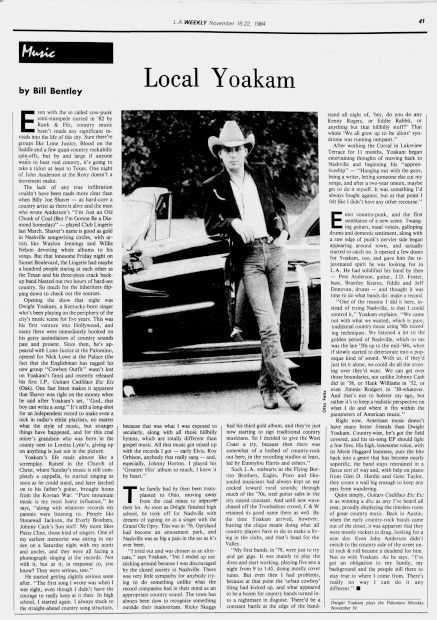
He enrolled at Ohio State in June 1975 while still living at home, but left the following summer. At 19, he headed to Nashville. The city, then more a publishing hub than a vibrant club scene, had little appetite for the stripped-down traditionalism he was playing. He returned briefly to Columbus before heading west in the winter of 1977, piling his belongings into a Volkswagen Beetle with former Greaser Billy Alves and driving to Orange County.
California did not offer immediate validation. Yoakam acted in a 1978 production of Heaven Can Wait at the Long Beach Playhouse and worked day jobs, including driving air freight trucks. Early bands played five sets a night in dives, mostly covers. He logged nearly a year playing three nights a week at the Corral in Lakeview Terrace and was close to giving Nashville another try when, in 1982, he met guitarist Pete Anderson.
That partnership changed everything.

Anderson understood both the Los Angeles scene and what Yoakam was trying to do musically. Together they recorded a six-song EP in 1984—five originals and a cover of Johnny Cash’s “Ring of Fire,” closing with “Miner’s Prayer,” dedicated to Yoakam’s grandfather Tibbs. Through a modest promote-and-distribute deal with Oak Records, the EP quietly entered circulation.
At the time, L.A.’s “cowpunk” movement had created space for roots-based artists in rock clubs. Yoakam wasn’t cowpunk—he was closer to what would soon be called “new traditionalism”—but the scene’s openness allowed him to find an audience. A showcase opening for Lone Justice led to wider attention. The EP reached Warner Bros. representative Paige Rowden, who signed him in September 1985.

By November, Yoakam and Anderson were back in the studio recording additional material. Reprise reissued the project in 1986 as Guitars, Cadillacs, Etc., Etc., retaining the original EP artwork. The album hit No. 1 on the country chart in June 1986. Yoakam won Top New Male Vocalist at the Academy of Country Music Awards and performed “Guitars, Cadillacs” at the 1987 Grammy Awards, where he received two nominations. He was no longer an outlier.

Sense of place is rarely simple. Home is not always where you were born, or where you spent the most time. Yoakam has often said, “Born in Kentucky, raised in Ohio, but I grew up in California.” His spiritual center appears to remain in southeastern Kentucky, and he is now synonymous with the Bakersfield sound—so much so that he hosts a Bakersfield Beat satellite radio channel.

But it was in Columbus that he learned to perform. It was here that he absorbed the cultural tension between Appalachia and the Midwest, between modesty and ambition. That duality shaped both his art and his worldview.
His impact on country music is undeniable. And however he defines home, Columbus was an essential chapter in the story. He'll always be considered one of ours.
Tracklist
Side one
Honky Tonk Man (Johnny Horton, Tillman Franks, Howard Hausey)
Bury Me (duet with Maria McKee)
Side two
Companies, etc.
Copyright © – Warner Bros. Records Inc.
Recorded At – Excalibur Studios
Recorded At – Capitol Studios
Mixed At – Hit City West
Mastered At – Capitol Mastering
Published By – Coal Dust West Music
Published By – Painted Desert Music
Published By – Tree Publishing Co., Inc.
Credits
Producer – Pete Anderson
Arranged By - Pete Anderson, Dwight Yoakam Engineer – Brian Levi

Musicians:
Vocals, Acoustic Guitar, Backing Vocals – Dwight Yoakam
Electric Guitar, 6-String Bass – Pete Anderson
Bass, Background Vocals on "I'll Be Gone" – J.D. Foster
Fiddle, Background Vocals on "Honky Tonk Man" – Brantley Kearns
Drums – Jeff Donavan

Additional musicians:
Piano – Glen D Hardin, Gene Taylor on "Ring Of Fire"
Pedal Steel – Jay Dee Maness, Ed Black on "Heartaches By The Number"
Dobro, Mandolin – David Mansfield


Comments