Omnipop - Butterfly

Jeff Ciampa’s reputation in Columbus has always been tied to his playing—the taste, the tone, the fluency of it. But what’s less widely acknowledged is how sharp his songwriting and production instincts are. Twenty-five years after the brilliant and ambitious My Imagined Life With Alfred Moore, Ciampa and his co-conspirators in Omnipop quietly released the beautiful, otherworldly Butterfly—a record that feels like both a continuation and a culmination of a lifetime spent refining music.
Butterfly
2025

Although not a band in the traditional sense, Omnipop reflects the unique chemistry and deep collaboration between Ciampa and drummer Tony McClung. Ciampa does the writing, and McClung, along with vocalist Jon Elliott and guitarist Josh Hill, provide input and inspiration, as well as their musicianship.

I’ve been a fan of these musicians since I first saw each of them playing live over the years. In 2019, my wife, Elisa Nicolas, was planning to record an album of her own. She asked me if I thought Birdshack (Ciampa, McClung, and Hill) would play on it. “Of course!” I said, but she wasn’t so sure. Thankfully, she asked, they agreed, and as a result, I got to see them working in the studio and got to know them as people well enough to consider them dear friends. And they are every bit as quality people as they are musicians.
Maybe that’s why I love talking to these guys: they’re Columbus lifers building little universes out of bass lines, drum parts, and guitar licks, all while remaining humble and empathetic people living for music and passionate about their craft. I wanted to understand how these musicians—who’ve contributed so much to Columbus’ sound—finally arrived at Butterfly.

We jumped on a Zoom call—Jeff from his studio, Tony on his porch on one of those in-between days in Columbus when the weather doesn’t know what it’s doing and neither does anyone else. Tony, relaxed and already laughing at himself, dove into the kind of candor that seems to come naturally after decades of playing, quitting, rejoining, touring, rehearsing, and arguing with a community of musicians, while Jeff provided a slightly more reserved brand of honesty and self-reflection.

The current Omnipop album has been out for about six months now, though at our age that still counts as “new.” And with singles released first—“Montreal” last April, “Lie To Me” in July, “Butterfly (What Would Love Do)” this past November—it feels like a project of and for its time, with the full album released in May 2025.
But before we got to the new music, I wanted to get the origin stories down—because so much of Omnipop as an entity is predicated on the zigzags that originally brought Ciampa and McClung together.
Jeff grew up in Windber, Pennsylvania—“tiny town, close to Johnstown, about an hour from Pittsburgh”—in a preacher’s home where church music and musicianship were constants. He landed at Otterbein because his parents met there, became a music ed major because it seemed practical, and then—like half the musicians I know—never actually used the degree the way the brochure intended.

Instead, he went on the Holiday Inn/Ramada Inn/Sheraton touring circuit in the early ’80s. Five or six nights a week, two weeks in the same town, learning pop songs by sheer volume. It’s a part of his story he talks about with a shrug, but it clearly shaped him: “It taught me a lot about pop music,” he says. You can hear it in everything he writes.
Somewhere along the line, Columbus jazz legend Bobby Floyd hired Ciampa, “and that was probably the most instructive period of my life, as far as being a musician, playing with Bobby Floyd and Joe Ong. Huge, huge developmental phase of my life.” Then came the Chillicothe Recording Workshop—an institution for untold numbers of Columbus musicians. Jeff went down constantly, playing on students’ projects, cutting his own demos, and learning production the way people learn languages: by immersion. Zero One was born out of those long nights and VHS-tape ADAT sessions.

Zero One developed a following, even landed a Sisapa Records deal with J.D. Blackfoot. There were limos. There was ‘fake it till you make it.’ And then came that moment when you realize you’ve been faking it longer than the money lasts.
And that’s when Ciampa started the band that would eventually become Omnipop.
Tony came from rural West Virginia—“beautiful, but nothing there”—and a bluegrass family. His uncle played the Opry a couple hundred times. That kind of musical imprinting never leaves you.

He arrived in Columbus in 1989 to join Flat Earth with West Virginia friends, working the Bernie's pipeline like so many before and after him. He remembers seeing Jeff sit in with Dr. Bombay; Jeff remembers seeing Tony at Dow’s on High. But their first real intersection was Outworld Cats with John Boerstler, Joe Crump, and Carl Schumacher.
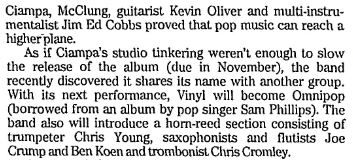
By the time Ciampa was putting together Vinyl (the band that would become Omnipop), Tony was the obvious drummer. Jeff still laughs remembering the night he dragged Jim Ed Cobbs to Dick’s Den to witness Tony playing with one hand after carpal tunnel surgery. “This is our guy,” he told him.
They’ve basically been stuck with each other ever since.
One question I’ve wondered for years: why doesn’t Jeff just release albums under his own name?
The simple answer: no one can pronounce it.

The Italian version is Champa. The Americanized version—Ciampa as “ky-AM-pa”—was an improvised choice from a neighbor trying to help Jeff’s grandfather fit in. The spelling is misleading enough that even changing the spelling (Jeff once released something as “Kyampa”) didn’t help.
But also, Jeff has always loved bands. Even when he’s the primary writer, producer, arranger, and general architect, he frames the work as a collective. “I do love the idea of a band, Beatles being my first inspiration, bands like The Police, even though there were specific songwriters, there was still a band entity. And especially with Vinyl and Omnipop, I mean, we were really a band.”
Vinyl had to become Omnipop after a call from their friend Jo Robinson, then a DJ in Chicago: there was an established band named Vinyl, and a lawsuit was the last thing anyone needed. So Jeff snagged the title from Sam Phillips’ Omnipop—a record recommended by my wife, Elisa.
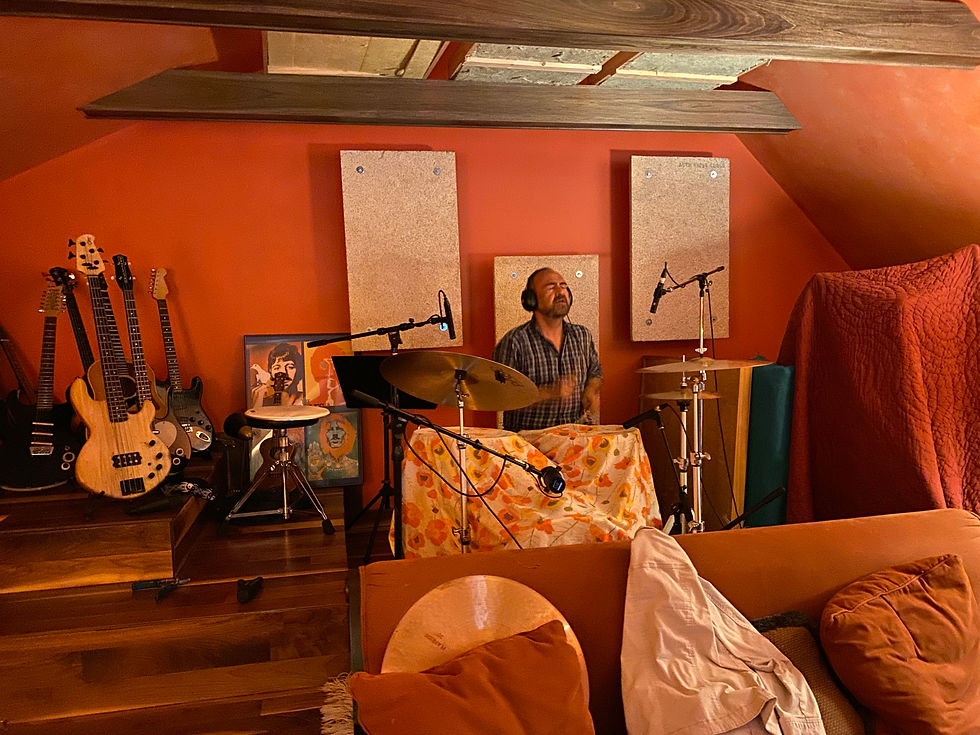
The new record—and really the new era of Omnipop—took shape during the pandemic. Jeff and Tony had tinkered with new tracks in 2017–18, but lockdown brought them into the same room more intentionally.
They also did the opposite of what two obsessive perfectionists normally do.

“We’re nitpickers,” Tony admits. “We’ll redo takes over and over and over.” But during lockdown, he’d show up at Jeff’s with a bottle of whiskey, they’d put a respectable dent in it, cut a track once or twice, and call it a day.
“It was more about the hang,” Jeff says. That looseness, that willingness to say what the hell, pushed the sound into stranger, more experimental territory. Tony—self-described contrarian—played against expectation. Jeff encouraged it. The result is some of McClung’s best drumming on record.
So is Omnipop a band? Jeff compares it to Steely Dan: a studio project with recurring characters. Tony insists it’s Jeff’s thing—his writing, his production. But at the same time, neither of them can talk about the music without talking about each other, or about Bobby Floyd, whose gravitational pull shaped both of them in ways they still process.

The songs on Butterfly have the tension of someone scanning the horizon for threats that may already be inside the room. Otherworldly, but also grounded in a way that feels very Columbus.
Jeff Ciampa writes from that place. Tony McClung destabilizes it in all the right ways. And together they’ve made a record that feels like late-night conversations between old friends—honest, weird, occasionally hilarious, and always reaching toward something just out of view.

What struck me most, sitting across from Tony McClung and Jeffrey Ciampa as we began to discuss vocalist Jon Elliott’s involvement on Butterfly, was how easily they talk about each other’s strengths and flaws with the kind of affection only people who've survived decades in a band can manage.
"Jon is the most agreeable guy in the world to work with,” Tony said, referring to Elliott. “And I don’t think Jeff and I are terrible, but we’re the opposite of that. Somebody could pay me to play on their record, and if I disagree? I’m gonna climb up their ass about something.”

Jeff laughed. “You’ve definitely lost gigs because of that.”
“Oh, I’m sure,” Tony shrugged. “But Jon… he’s the lead singer who doesn’t identify as the lead singer. Whatever ideas somebody has, he’ll go, ‘Great.’ He enjoys being a sideman. And he’s really great at it.”
Jeff nodded. “Yeah, he's amazing. I’d send him demos with my scratch vocals, and he’d come back and sing them pretty much the way I sang them. And then I would say, ‘Okay, now give me a little more Jon in there,’ or ‘Give me a little Stevie,’ and he’d just do it. He’s like a character actor on every song. And I think he loved the songs. I mean, I don't think he would have done it otherwise.”

Right around then, Tony realized he was late for something — he always is — and bolted for the door with quick goodbyes. As soon as the door clicked shut, Jeff turned to me and grinned: “Alright. Now we can talk about Tony.” I think Tony may have just not wanted to steal any limelight from Jeff. That’s really who Tony is. He’d text later to make sure we discussed guitarist Josh Hill and to be on the record saying Josh is “the best guitarist anywhere.”

In fact, Hill was the very next topic of discussion. One of the biggest differences between the new album and Alfred Moore, hilariously named after Tony’s mishearing of the lyric “you might imagine life would offer more,” was the shift from Kevin Oliver to guitarist Josh Hill. Hill takes technique and imbues it with a soulfulness that makes it feel like he’s talking directly to you with his instrument.
“It’s got more of a jazzy feel,” I said, “as opposed to the funkier thing on the first Omnipop record.”

“Oh, absolutely,” Jeff said. “I tried not to think about commercial aspects, but there’s always that subconscious voice asking if people will like it. This time I just said, ‘Fuck it.’ Jazz has always been a thread in my life — not my first love, but a part of me. I’m not a jazz musician, but I play at jazz so I can be better at everything else.”
He paused for a moment.
“My rock star days were when I was in my 20s,” he added, “jazz today is the pinnacle of musicianship, and of harmonic exploration, melodic exploration, everything. And so I wanted to try to introduce a little bit more of that into this album.”

That musical DNA is all over the record: Steely Dan, Miles Davis, Weather Report. Jeff laughed about how Yacht Rock brought some of that back into cultural acceptability — ironically at first, and then people realized, wait, this is actually great music.
When I asked about releasing singles first, Jeff admitted it was the one moment where commercial strategy entered the process. “You finish the album and think, okay, how do I get people to hear this thing? We mostly failed miserably at that,” he said, laughing, “but the intention was there.”

The artwork came from Donnie Mossman, whose list of creative pursuits is so long it requires a deep breath to recite. Jon Elliott brought him into the fold. And yes — the digital age has ruined liner notes. The world isn’t built for albums like this anymore, the ones with details worth discovering.
Jeff’s daughter Maddie sings on one track, “Be Alright,” and Josh plays guitar on three songs. Everything else — horns, strings — comes from carefully chosen samples.

“I considered replacing all of those parts with real players,” Jeff said, “but I found some sounds that I really liked, and there was a kind of continuity to using the same flugelhorn, muted trumpet, and tenor sax patches throughout.”
It’s been 25 years between Omnipop albums, so I asked whether he’d been writing all along or working slowly and deliberately.
“Mostly the latter,” he said. “I go through phases where I feel empty if I’m not creating something. Then long periods where I don’t feel that at all. But it almost always comes around to: why am I here? What’s my purpose?”
He talked about “GOTD” — Groove Of The Day — a discipline he created where he forces himself to write something, anything. He has hundreds of these grooves stored away.

And yes, he writes music first 99% of the time.
“I hate stupid lyrics,” he said, “but I don’t consider myself a great lyricist. I just get them to the place where I feel like, ‘this works.’”
When I told him the new album felt more melodic, he nodded. The first Omnipop record was groove-forward; this one is more about movement and contour, reflecting the jazz influence.
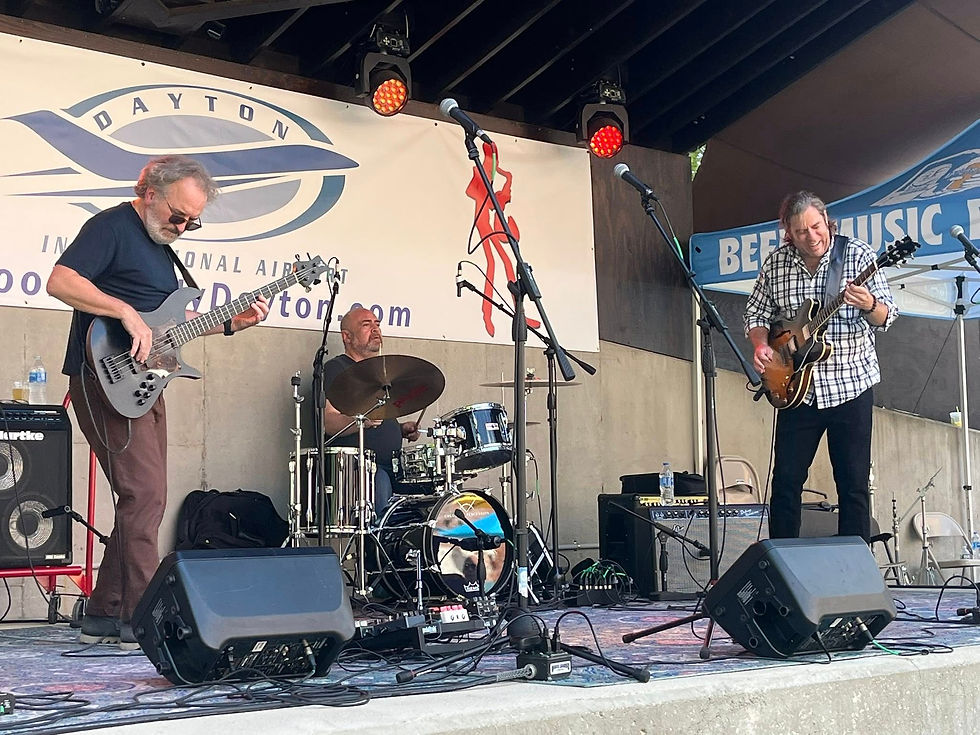
On the Weird Music podcast, the host had asked how Hoodoo Soul Band had survived all these years, and Jeff had shrugged off the question at the time. I told him what I really thought: “It’s because you and Tony haven’t killed each other, right?”
“Oh, we’ve come damn close,” he said. “We’re both temperamental. Both perfectionists. But where our loves and music intersect, it's what makes us tick. It's kind of amazing that it keeps going, but it does...”
I told Jeff something I’ve believed for years: Omnipop is the main project where Tony really lets loose on record. Not in an over-the-top way, but enough that you hear his full chops.

“Oh, I push him,” Jeff said immediately. “Tony so respects the groove and the drummers he loves aren’t flashy. Live, he’ll go off. But in the studio he’s usually a parts player… it's not always the expected parts. But he's always like, ‘this is what this song needs, and I'm gonna lay this down.’”
Jeff talked about comping drum takes — grabbing fills from different performances to build the perfect track.
“I take part blame and part credit,” he said. “Sometimes I just tell him, ‘Play a fill, goddammit.’”
Before we wrapped, I finally asked about the Wayne Shorter connection — something I’d always wondered about.

It all traced back to Rob Griffin, a California via Columbus mandolin virtuoso whose career detoured to engineering when he injured his hand. Griffin eventually became Wayne Shorter’s live and studio engineer, and when he moved back to Columbus, Paul Brown connected him with Jeff.
Rob liked Jeff’s ears and musical instincts. That led to Jeff assisting on four live Shorter albums — including two Grammy winners — mostly in editing and mixing. He even toured as a kind of all-purpose assistant.

“It was surreal,” he said. “My biggest claim to fame is something I’m an amateur at, as an engineer. But right place, right time.”
Listening to Butterfly now, it’s impossible not to hear echoes of everything that shaped Ciampa—church music, club nights, jazz gigs, ADAT sessions, even the experience assisting Wayne Shorter. It’s the long arc of a life in music distilled into ten songs. When I asked about future plans — and whether it’ll be another 25 years — he laughed.
“I don't think that's physically feasible, but, who knows?”
A show isn’t off the table, but he’s realistic.
“I don’t want to do it with tracks. I’d want a real band, a horn section, and the music is not easy. It’s a lot to ask for one or two gigs.”

I joked that he could record the shows and release a live album.
Who knows?” he said. “I wouldn’t count it out.”
As we wrapped, he told me, “The ball’s in your court now, Drew.”
Thanks, Jeff. I'll see what I can do.
Tracklist
3 Montreal
6 Dopamine
10 Escape
Credits
Written & Produced - Jeff Ciampa
Bass, keyboards, vocals - Jeff Ciampa
Drums - Tony McClung
Vocals - Jon Elliott
Guitar - Joshua Hill (track 1, 4, 8)
Vocals - Maddy Ciampa (track 9)
The moment I get to where I’m going is the moment I am planning my escape

Comments