Tony Monaco Trio – Burnin' Grooves

Most people would probably be surprised to learn how common it is for world-class musicians to toil in obscurity throughout their lives. Often, listeners simply don’t recognize the level of talent they’re hearing. That lack of recognition can add fuel to the self-doubt that often plagues artistic types. More often than not, they hold day jobs to make ends meet and never get their big break. Maybe they don’t even seek recognition.
Burnin' Grooves
Summit Records - DCD 304
2001
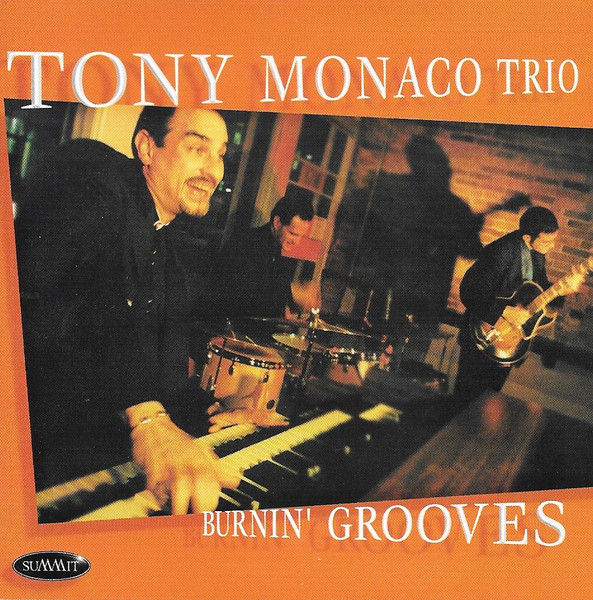
Success in any profession has a lot to do with relationships, timing, connections and plain luck. Nowhere is that truer than in the world of art, where beauty is in the eye of the beholder and technical proficiency has surprisingly little to do with success. Breaks can come in all shapes and sizes and lead to varying levels of critical and commercial success.

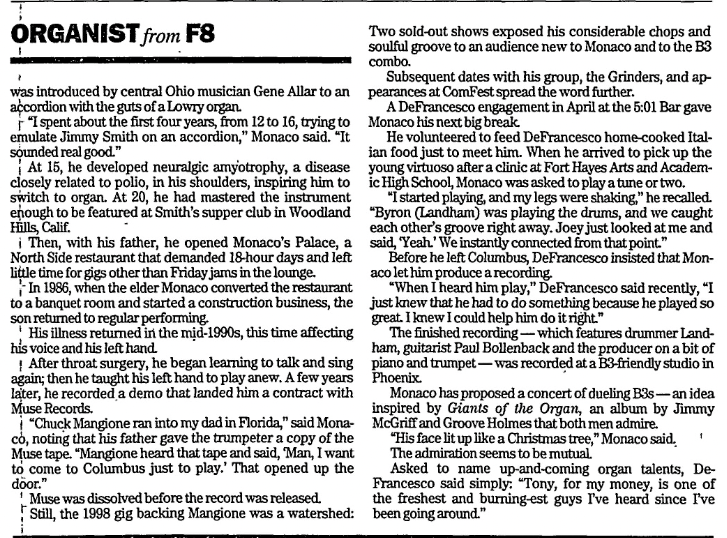
For Columbus organist Tony Monaco, a chance encounter with young jazz phenom Joey DeFrancesco led to the kind of national recognition his talents warranted. If it didn’t bring a level of fame that essentially doesn’t exist in the jazz world, it at least allowed Monaco to focus more fully on his art and establish himself as a respected Hammond B3 player. The 2001 Summit Records release Burnin’ Grooves was one of the first fruits of Monaco’s relationship with DeFrancesco.


I became aware of DeFrancesco through his work on John McLaughlin’s mid-’90s releases Tokyo Live and After The Rain. With McLaughlin being one of my favorite musicians and Hammond organ one of my favorite instruments, I loved these brilliant trio albums with Dennis Chambers and Elvin Jones on drums. So, when DeFrancesco was quoted saying that Monaco is “some of the best Jazz Organ being played today,” my ears perked up. Although Tony had been gigging in Columbus for as long as I’d lived here, it wasn’t until I heard Burnin’ Grooves that I became a fan.
Monaco graciously spoke with me via Zoom about the album and his experience in the business. He had just been through a difficult period after losing his father and had gone several years without playing regularly. At the same time, he was running the family construction business. His father had started the company in the 1950s, and Tony and his brother were now running it. With three daughters to support, music was not his livelihood.

“My main bread and butter was the construction business, because that’s how I was gonna put my kids through college and pay for their weddings,” Monaco told me. “And I was still playing music on the side. I’ve always played. But it wasn’t my forefront.”

That changed unexpectedly in April 2000, when musician/promoter/DJ Jim Maneri told Monaco about a new jazz club opening in Columbus and asked if he knew anything about the young organist who would be opening it. Monaco knew the name Joey DeFrancesco, but not much about his playing. He had stopped buying Jimmy Smith records years earlier and wasn’t keeping up with the latest jazz releases.
Monaco offered to provide DeFrancesco with his mom's authentic Italian home cooking. When he went to pick him up at Fort Hayes Career Center, where DeFrancesco was giving a clinic, Monaco ended up playing with the band. DeFrancesco’s reaction was immediate.

“I looked over at Joey,” Monaco recalled. “And he did one of those, you know, his eyes popped up.”
On the drive to Monaco’s mother’s house, DeFrancesco asked what he was doing with his music career. Monaco explained that his father had recently died, that he was running the construction business and that he had been playing music on the side.

“He said, ‘Well, you should come to Phoenix and let me produce you.’”

Monaco had the financial means to make the trip, thanks to the construction business, and in the summer of 2000 he went to Hunnicutt Recording's Arizona studio. They recorded for two days with DeFrancesco’s trio, and Monaco initially had modest expectations.
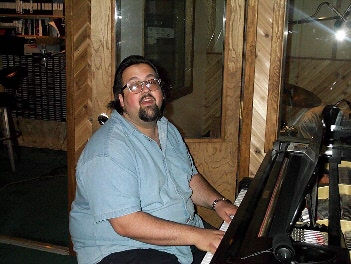
“What an honor,” Monaco said. “My thought was, you know, that I’d have a nice project for my kids. I wasn’t even thinking outside that box.”
DeFrancesco also suggested that he might be able to get the project heard by Concord Records, but the label passed. The recording business was already changing, and Monaco found himself with a finished project but no record label. The resulting recordings were released independently as Out Of Nowhere! in November 2000.

“One of my dreams was to be released as a recording artist,” Monaco said. “Back in those days, if you didn’t have a national release on a record label, you didn’t get the publicity as being a national or international artist. You were local.”
Monaco began shopping the project himself. He attended the International Association of Jazz Educators convention in New York, spending three days visiting record-label booths and handing out CDs and promotional material.

“I couldn’t get anybody interested in it,” he said. “It’s tough. It’s hard.”
Then he encountered Summit Records, a small label based in Phoenix. Monaco immediately sensed something different about the people running it.
“The guys at Summit were different than the other guys,” he said. “They were more Midwest kind of guys. There was no attitude, there was nothing.”
Summit was interested, but there was a catch. The label felt the project needed more blues to make it marketable. Monaco understood the business side of the decision, even if it meant altering a project he would have preferred to leave intact.
“I thought it would have been better to leave the project intact with the trio that I had (on Out Of Nowhere!) instead of mixing it up like that,” he said. “But hey, you know, that’s what was necessary for me to get the deal.”
Monaco called Steve Carter, whose Thornapple Studio was located off Westerville Road, and assembled a Columbus trio to record additional material. He had known guitarist Derek DiCenzo and his family since their days at St. Michael’s, and he had been playing gigs with drummer Louis Tsamous. The trio recorded three additional tracks.

Those songs were combined with material from the DeFrancesco sessions to create Burnin’ Grooves. For Monaco, getting the album onto a label was more important than the financial terms.
"I got 500 CDs, and the artwork, and I was out on a real label that had distribution," he said. "That was my main concern. Because back then, if you didn’t have distribution, you didn’t have anything.”

DeFrancesco’s name and endorsement gave Monaco credibility outside Columbus. He had been discovered, in a sense, by someone who already had an international reputation.
Monaco went all in on promoting the record. He hired radio and press promoters and bought advertisements in JazzTimes, Jazziz and DownBeat. Then Burnin’ Grooves was released in September 2001.
And then September 11 happened.

“All that money I spent, it all was basically over-washed by the news,” Monaco said. “Rightfully so, of the tragedy we had.”
Rather than let the setback stop him, Monaco went back into the studio. His next album, Master Chops T, was more heavily produced and ultimately had greater commercial success. Looking back, Monaco sees a clear distinction between the two records.

“Burnin' Grooves was more about, you know, burning, playing,” he said. “Master Chops T was a little bit more produced.”
The second album helped revive interest in the first. “Master Chop’s T pulled Burnin’ Grooves out of the ashes a little bit,” Monaco said. “But I lost a big chunk of money putting that out. But I had the momentum started.”

That momentum would carry Monaco into a recording career that eventually produced a long string of albums and established him well beyond the Columbus scene where he had spent so many years playing. But Burnin’ Grooves wasn't the result of some carefully plotted career strategy. Monaco was running a construction company, raising three daughters and playing music when he could. A chance meeting with Joey DeFrancesco opened a door, and Monaco had the resources and determination to walk through it.

Sometimes a break finally gives the world a chance to hear what you've been doing all along.
Tracklist
Companies, etc.
Phonographic Copyright ℗ – Summit Records
Copyright © – Summit Records
Mastered At – Sonorous Mastering, Inc.
Credits

Tracks 1, 3, 5, 6, 7 & 8
Producer – Joey DeFrancesco
Recorded At – Hunnicutt Recording Studios, Phoenix, AZ
Hammond B3 Organ & Vocals – Tony Monaco
Piano – Joey DeFrancesco
Guitar – Paul Bollenback
Drums – Byron Landham
Tracks 2, 4 & 9
Producer – Tony Monaco
Recorded At – Thornapple Studios
Hammond B3 Organ – Tony Monaco
Guitar – Derek DiCenzo
Drums – Louis Tsamous
Executive-Producer – Darby Christensen, Kip Sullivan, Tony Monaco
Package Design – Anvil 88 Creative Studio


Comments